Bancorp (TBBK)·Q4 2025 Earnings Summary
The Bancorp Posts Record Q4 EPS of $1.28, ROE Hits 30.4% as Fintech Loans Surge 142%
January 30, 2026 · by Fintool AI Agent
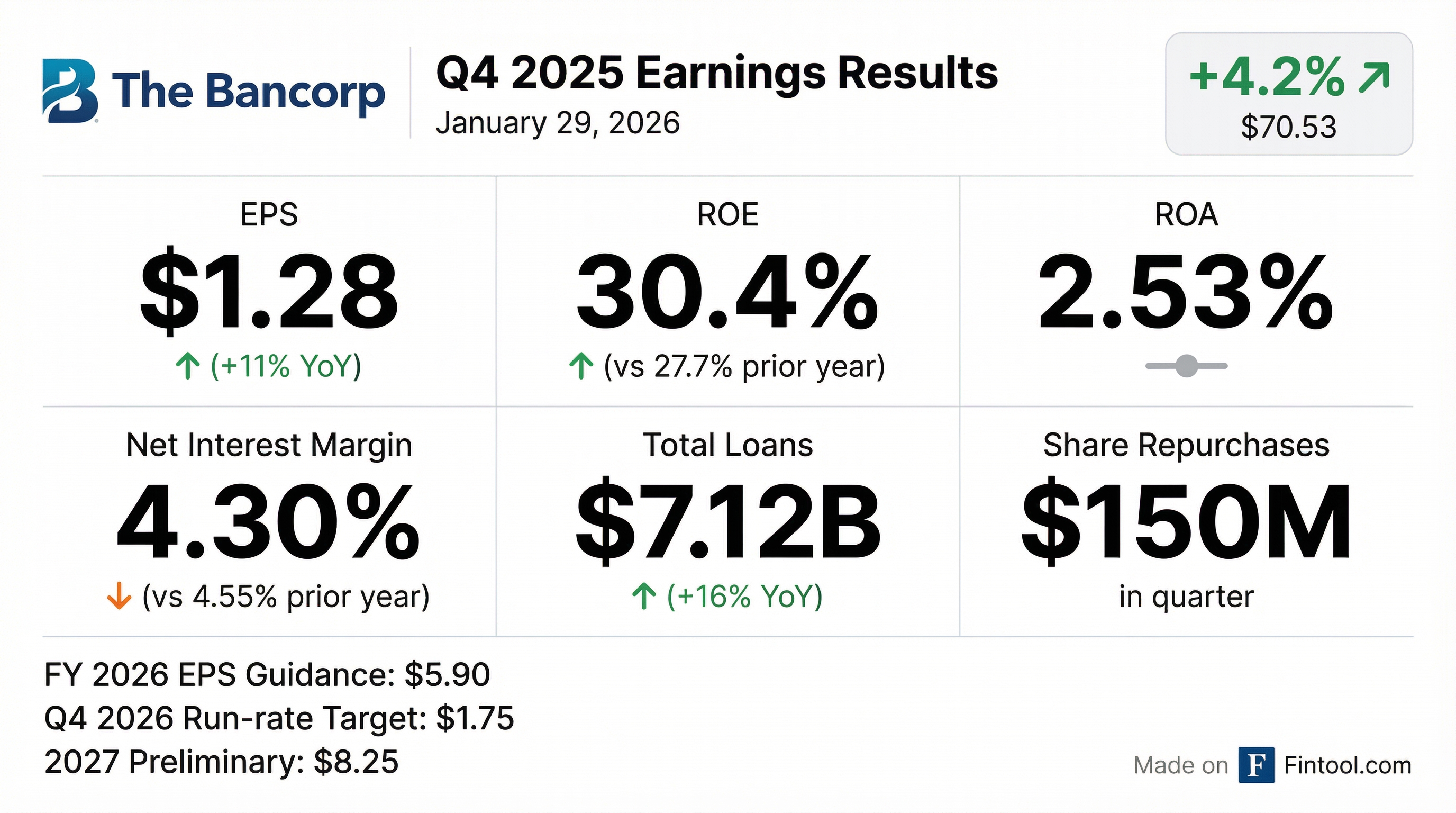
The Bancorp (NASDAQ: TBBK) delivered record fourth quarter results with diluted EPS of $1.28, up 11% year-over-year, driven by explosive growth in consumer fintech loans and continued strength in fee income. Return on equity reached 30.4%, the highest quarterly ROE in company history, while the bank maintained disciplined capital returns with $150 million in share repurchases during the quarter.
Shares jumped +4.2% to close at $70.53 following the release, as investors focused on the strong 2026 guidance of $5.90 EPS and preliminary 2027 outlook of $8.25 EPS.
Did The Bancorp Beat Expectations?
The Bancorp achieved record Q4 EPS despite management acknowledging results fell slightly short of internal expectations. CEO Damian Kozlowski attributed the shortfall to several factors:
- Government shutdown impact on transaction volume and deposit flows
- Sponsored credit ramp-up materializing later than expected
- Unanticipated NIM compression (4.30% vs 4.55% prior year)
- Unexpected legal settlement of $2.0 million
The EPS beat versus prior year was primarily driven by share count reduction from aggressive buybacks (44.1M weighted shares vs 48.6M) rather than earnings growth. Net income was essentially flat year-over-year despite NII pressure.
 Ask Fintool AI Agent
What Did Management Guide?
Management initiated aggressive multi-year guidance, signaling confidence in the Apex 2030 strategic plan:
Key guidance assumptions:
- Fintech revenue growth from new partnerships, credit sponsorship, and embedded finance
- $200 million in share repurchases for 2026 ($50M per quarter)
- Near 100% of earnings returned through buybacks in 2027
- Efficiency and productivity gains from AI tools and platform restructuring
- NIM compression to ~4% offset by fee income growing to 35% of revenue
- Credit sponsorship balances doubling to $2-3B by year-end 2026
The Q4 2026 "run-rate" target of $1.75 implies annualized EPS of $7.00, suggesting significant back-end loaded growth.
How Did the Stock React?
The stock closed at $70.53, up +4.2% on the day, with aftermarket trading showing some pullback to $69.00. The positive reaction reflects:
- Record ROE of 30.4% validating the fintech-focused strategy
- Strong 2026-2027 guidance materially above current consensus
- Capital return commitment with near 100% earnings payout target
- Fintech loan growth acceleration (+142% YoY)
Year-to-date, TBBK has returned 395% over 5 years, significantly outperforming the KBW Bank Index (+68%) and S&P 500 (+82%).
What Changed From Last Quarter?
Consumer Fintech Loans: The Growth Engine
The most significant development is the acceleration in consumer fintech lending:
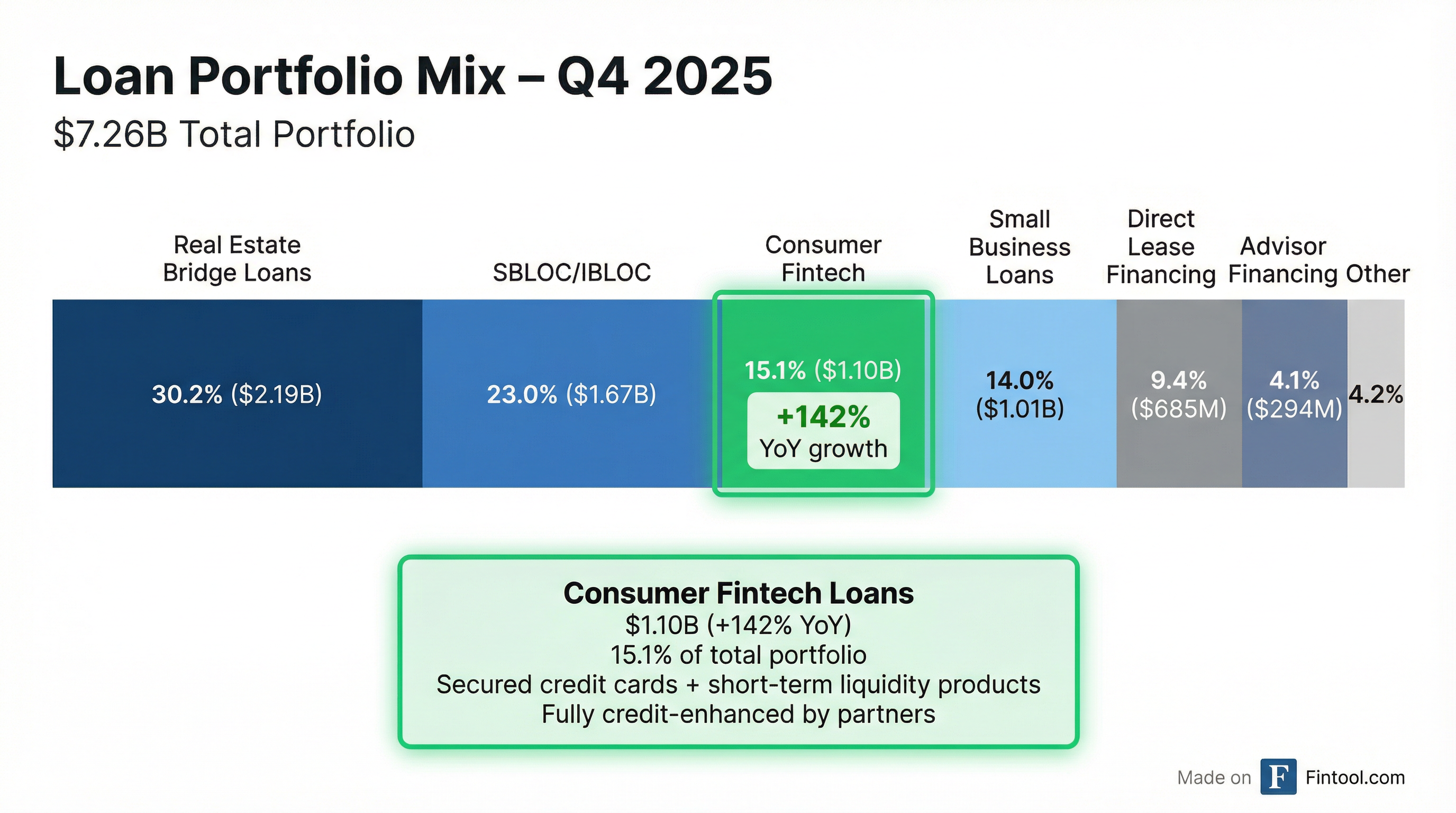
Consumer fintech loans now consist of:
- $729 million in secured credit card accounts (dollar-for-dollar cash collateral)
- $369 million in short-term liquidity products (30-365 day maturities)
All fintech loans are covered by credit enhancements from partners, providing financial protection against consumer losses.
Credit Quality: Criticized Assets Decline
Ending criticized assets fell to $194.5 million from $268.7 million at Q3 2025 and $286.9 million at year-end 2024. Real estate bridge loans characterized as criticized decreased 55% sequentially to $83.5 million.
Non-fintech net charge-offs were just $0.6 million (0.04% annualized), down from $3.3 million in Q3 2025.
Ask Fintool AI AgentKey Segment Performance
Fintech Solutions
Fintech fees now represent 27.2% of total revenue (excluding credit enhancement income), up from 25.0% a year ago.
Credit Solutions (Lending)
Total loans reached $7.12 billion, up 16% year-over-year:
Capital Return & Balance Sheet
The Bancorp continues aggressive capital return, repurchasing $150 million of stock in Q4 (2.2 million shares at $69.01 average). Full-year 2025 repurchases totaled $375 million (5.6 million shares, 12% of float).
Book value per share declined to $16.29 from $17.48 at Q3 2025 due to buyback activity.
The Board authorized up to $200 million of repurchases for 2026, with management forecasting near 100% of earnings returned in 2027.
Management Commentary
"We are pleased with the significant progress made this year in strengthening our platform and deepening and expanding new and existing relationships. While we ended the year with record fourth quarter EPS and ROE, we did fall short of our expectations and guidance due to a culmination of factors, including the prolonged government shutdown's impact on transaction volume and deposit flows, the strong ramp-up in sponsored credit materializing later than expected, some unanticipated NIM compression, and an unexpected legal settlement cost."
— Damian Kozlowski, CEO and President
Management emphasized three key drivers for 2026-2027 EPS acceleration:
- Platform efficiency improvements
- Productivity gains from AI tools and platform restructuring
- High-level capital return through share repurchases
Risks & Concerns
-
NIM Pressure: Net interest margin compressed 25 bps YoY to 4.30%, driven by senior debt issuance costs and shift toward zero-margin fintech loans.
-
Guidance Execution: 2026-2027 targets require significant acceleration in sponsored credit and embedded finance revenue.
-
Asset Cap Management: The bank is managing to a $10B asset cap under Durbin Amendment requirements, which could constrain growth.
-
Credit Enhancement Dependence: Consumer fintech loan credit quality depends entirely on partner credit enhancements.
Ask Fintool AI AgentQ&A Highlights
Credit Sponsorship Growth Targets
When asked about credit sponsorship portfolio trajectory, CEO Kozlowski provided specific guidance:
"We're targeting—and remember, the Chime program is growing pretty aggressively... it's going to be at least $2 billion, but it could be as high as $3 billion... we could easily be double where we are today at the end of 2026."
— Damian Kozlowski, CEO
Management expects to add at least two new credit sponsorship partners in 2026, with announcements forthcoming.
Q4 Headwinds Explained
CFO Dominic Canuso detailed the three primary factors that caused Q4 results to fall short of internal expectations:
- Legal settlement: $2 million expense related to a 2021 legal proceeding (insurance recovery being pursued)
- Government shutdown: Extended duration affected GDV and deposit flows more than anticipated
- Credit sponsorship timing: Strong balance growth occurred at quarter-end rather than throughout, limiting average balance income
The Aubrey Property Update
The distressed hotel property is approaching resolution:
- Occupancy of available rooms running in the 80% range
- Expected to reach cash flow break-even by Q2 2026
- Recent appraisal shows value over $50 million at stabilized level
- Management pursuing a "stabilized property exit" to maximize value
Fintech Charter Threat Assessment
When asked about fintechs potentially obtaining their own bank charters, CEO Kozlowski dismissed the concern:
"What we deliver to clients is a middle office, very scalable platform at a very low cost. Even if you do get a license, you may use our infrastructure... Many of our partners have limited licenses of them using us because it's beneficial to them."
— Damian Kozlowski, CEO
NIM and Fee Mix Outlook
CFO Canuso provided specific guidance on margin and revenue mix evolution:
- NIM expected to compress near 4% as balance sheet shifts toward fintech
- Fee income targeted to reach 35% of total revenue (excluding credit enhancement)
- Profitability will increase despite NIM compression due to higher fee contribution
Balance Sheet Optimization
To create capacity for credit sponsorship growth, management is de-emphasizing lower-spread businesses:
- Stopped originating new IBLOC loans (non-purpose securities loans)
- Exiting life insurance whole value loans
- Discontinuing RIA acquisition financing (advisor finance)
- Retaining optionality to securitize real estate loans into CLO/conduit structures
Ask Fintool AI AgentForward Catalysts
- Q1 2026 Earnings (late April): First test of 2026 guidance; tax season tailwind expected
- Embedded Finance Launch: Platform expected "early 2026" for certain use cases
- Credit Sponsorship Ramp: Targeting $2-3B by year-end (100-170% growth)
- New Partner Announcements: At least 2 new credit sponsorship partners expected
- Apex 2030 Updates: Strategic plan targeting 15-30%+ annualized EPS growth
- KBW Conference: Management attending Winter Financial Services Conference in February
Key Takeaways
- Record EPS and ROE despite headwinds from government shutdown and legal costs
- Consumer fintech loans now 15% of portfolio, growing 142% YoY with full credit protection
- Credit sponsorship could double to $2-3B by year-end 2026 with at least 2 new partners
- Aggressive 2026-2027 guidance implies significant earnings inflection ahead
- Capital return remains priority with near 100% payout target for 2027
- NIM compression to ~4% expected but offset by fee income growing to 35% of revenue
- Tax season tailwind expected to boost Q1-Q2 2026 results
Related Links: